


The 'third place' problem
Updated: Dec 10, 2025
By Jonny Wall
The glow of computer monitors spills across clusters of tables at Reforged Gaming Lounge in North Charleston.
Conversations overlap, rising above the clicking of game controllers and the frequent hiss of beer taps. For a moment, everyone belongs. Strangers become teammates, regulars trade inside jokes, and the air hums with shared energy.
“It's important for this place to continue to exist. What happens when this goes away?” CEO Chris Dugan asked, glancing around the room filled with players and chatter.
He takes pride in cultivating a space designed not just for gaming, but for belonging.
“Our long term goal is to normalize people gathering again over something they can be passionate about," Dugan said.

But third-place experiences like Reforged are becoming few and far between.
Across the country, the vanishing of third places, the informal gathering spots between home and work, has quietly deepened a loneliness crisis that’s now considered a public health concern.
In a 2023 advisory, the U.S. Surgeon General issued a stark warning -- a lack of social connection can increase the risk of premature death by 29%, a danger comparable to smoking or obesity. Meanwhile, a 2024 Time Magazine report found that 17% of Americans now say they have zero close friends, a staggering rise from just 1% in 1990.
Younger generations appear to be suffering the most.
A Pew Research Center study released in 2025 found that one in six Americans feel lonely or isolated most or all of the time. Pew also reports that nearly half of U.S. teens (46%) say they are online “almost constantly.”
Despite unprecedented digital connectivity, genuine human connection has become harder to find.

The rise of digital “third places” like online communities and social media groups offers a substitute, but not a solution. These spaces can bring people together, but often lack the spontaneous, physical intimacy that fosters a sense of belonging.
As Dugan plainly put it, “Humans are communal animals. They were reliant upon the tribe, that does not change.”
For many young people, the search for their “tribe” begins on college campuses.
Universities remain one of the few modern environments where people are encouraged to explore interests collectively. Clubs, student organizations, and informal groups act as essential third places where connection happens organically.
Research from the University of California’s Institutional Research and Academic Planning office found that students engaged in extracurricular activities report a higher sense of
belonging and are more likely to persist in school.
A 2025 feature by The Guardian reinforced this – 94% of students in sports clubs reported stronger feelings of belonging, and U.S. students in extracurriculars were found to be five times more likely to remain enrolled.
A campus of strangers, a club of friends
On campus at the College of Charleston, the search for belonging often begins with one question – Where do I fit in?
The answer isn’t found in classrooms or dormitories, but in the third places students create for themselves, like clubs, teams, or spaces of shared passions where social walls vanish.
Like many students, Kara Floyd and Dylan Corbin remember how isolating college life can feel – surrounded by thousands of people, yet struggling to find meaningful relationships.
“I had a lot of trouble meeting people and making friends freshman year. You meet so many people, none of them stick,” Floyd confessed.
Becoming an officer for the campus Comedy Club opened her to a world of new friendships.
“The difference with comedy clubs is that you actively have to talk to people to make them laugh,” Floyd said. “And I think that makes people want to talk more and go out of their own shells.”
Through shared laughter, she discovered an audience and confidence.
“People are able to communicate their ideas and their feelings better in the club,” she said. “I used to have severe social anxiety… I couldn’t look people in the eyes. I couldn’t speak in public. Look at me now!”
Even though she found her social footing, Floyd still catches a reflection of herself in other students, which inspires her to look out for those struggling to connect.
“I see myself in so many people,” she said. “Every little freshman dork, I see myself in them… I always want to reach out to those people.”
Dylan Corbin, president of the CofC WarGaming Club, solved that same need for connection not with laughter, but with dice, miniatures, and rulebooks.
“I know a lot of people are pretty socially reclusive,” he said. “But when it comes to a thing they like, they will get out of their shell.”
The appeal of the club was simple – it was a way to meet people in an environment that didn’t demand anything but participation and passion.
“The big thing is that despite being in college, socialization on campus is so difficult,” he said. “It’s a way to make friends… and that’s hard.”
Corbin thanks the club for strengthening his social relationships, turning acquaintances into lifelong friends.
Participation in campus organizations, like Floyd and Corbins, give students something to rally around, a shared interest that can break the ice and remove possible barriers to social connection.
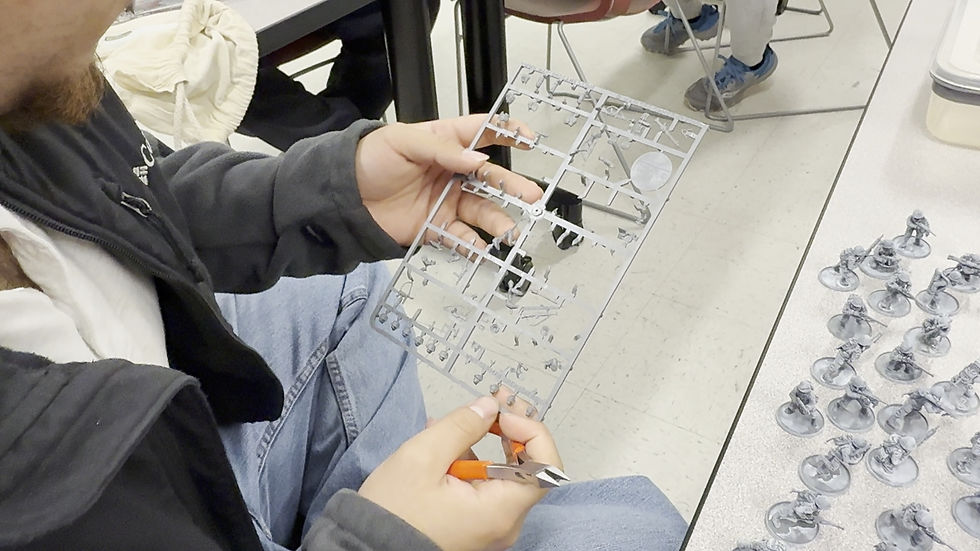
“It’s hard to bridge the gap in conversation. It feels like you have to convince someone, like, ‘hey, I’m not evil,’” he said. “When you have a facilitator like a club, it bridges that gap. It is a common interest.”
An Ohio State University Involvement Study found that participation in co-curricular activities is positively correlated with academic performance, well-being, and leadership development.
But once the dense web of community that defines college life fades away, many students find themselves back on the outside of socialization.
Out of the frying pan, into the fire
College campuses are rich with built-in third places: student centers, club meetings, and study lounges. But once that protective structure disappears, so too do the opportunities for organic connection.
That’s why the transition after graduation can feel like a social suckerpunch, immediately reintroducing the difficulty of finding community.
”Once I graduated, basically all of my friends moved out of Charleston, and I was one of the only people that stayed here out of my little friend group,” said 2025 CofC graduate Casey Riley. “So it was almost like taking on a new perspective.”
Riley had trouble coming to terms with the dramatic shift. She went from being highly visible and active socially, often dubbed the "social media girl" on campus, to battling feelings of disconnection.
“I’m struggling with this imposter syndrome almost,” she admitted. “I was very involved on campus, and then you get into post-grad, and it feels like no one knows that I’m good at anything anymore. It's a very interesting switch up.”
In the absence of her once close social circle, Riley had no choice but to actively seek out new doors to reclaim that sense of belonging.
On the other side, she was met with the College of Charleston and School of Business Run Clubs, a community of runners who meet weekly to jog and unwind, brought together by the shared challenge of fitness.
“I feel like the running and fitness community is something that comes more naturally and it's easy to bond over,” she said, stressing the need for a social outlet. “A lot of people in Charleston feel like the way to do that is going out and drinking on the weekends, which I quickly realized wasn’t necessarily my scene.”
These run clubs provided a crucial, intentional, and shared-interest anchor in her busy work week.
“It’s nice to have friends in those communities where it's like, okay, I know at 6:30pm on Thursdays, I'm going to be seeing all these people so I can look forward to that,” she added.
As Riley gets acclimated with full-time employment, she feels separating work from socialization is more relevant than ever.
“I love my job, but I think it's important to detach from it at the end of the day because you don't want to make work your whole life,” she said. “When 5 o'clock rolls around, disconnect the work conversations, turn them into friendly conversations.”
Dugan agrees with this sentiment, partly because separating work and social life has become borderline impossible.
“You're supposed to be enjoying things that you're passionate about, right? And sometimes you can no longer do that in the first place. Unfortunately, the second place has invaded the first place. So now, it's 1A and 1B. There isn't really a second place anymore, it became 1B.” - Chris Dugan
This crossing of boundaries between work and life places immense and necessary value on the true third place, which is now besieged from all sides.
The 'third place' problem
While the lines between the first place (home) and the second place (work) have blurred, the third place has been strategically sidelined by technological and economic pressures.
The digital world provides the most imposing and immediate competitor to physical third places.
That's in large part to the rise of online communities, like Discord, a social media that allows users to create groups and interact with each other, serving as arenas for social connection where the third place once stood many years ago.
SQ Magazine reported that ages 25-34 dominate 53.43% of the global Discord user base and ages 16-24 trail behind with 20.60% of the share. With close to 75% of users being under 34, younger people have turned to the convenience of online channels over the connection of physical spaces.

On top of that, 42% of Gen Z internet users report interacting with Discord weekly. This convenience and frequency often replaces the social rituals of yesterday, from after-work drinks to gatherings at the local park.
But it's no coincidence that the popularity of the internet has contributed to the decline of those once sacred meeting areas.
Readers may recall the shared experience of visiting shopping malls, which once functioned as sprawling, climate-controlled third places.
These former consumer meccas, where people spent hours, are now largely vacant and abandoned across the United States.
Online shopping, spearheaded by giants like Amazon, has severely cut the staying power of physical retail and the social infrastructure it provided for people.
Capital One Shopping Research indicates that up to 87% of large shopping malls may close within the next decade, taking with them one of the last remaining large-scale, casual third places.
Creating spaces like Reforged Gaming Lounge is difficult when keeping them alive and thriving is half the battle.

The convenience of Discord and social media is free; but the cost of a physical gathering space is not.
With operating costs—particularly rent, utilities, and labor—rising sharply across the United States, physical third places have lost financial footing and sustainability.
The economic reality is proof: a 2025 report by Coresight Research is tracking up to 15,000 store closures this year alone, easily outpacing the 2024 number.
“We just had to raise prices here for the first time, and I didn't want to do it, but you got to,” Dugan said. “Every single food item that we purchased and served here has gone up between 15 to 40% at cost since we opened. It hasn't even been a year.”
Dugan believes the numbers tell a bigger story though, one about making necessary changes for customer access.
“We wanted to keep it as affordable as possible for everyone to work into their budget,” he said. “It's just something where you feel like when you're here, that you're not like, I need to have a credit card when I come here.”
Third places shouldn’t break the bank in order to participate, and the same can be said for social connection. This pricing pressure is why community leaders like Dugan see their spaces not just as businesses, but as essential public goods.
In his view, the survival of third places depends on those willing to build them as cornerstones of community life.
“The most important thing any person can do in my generation and the generation coming up is create a business where you create livelihoods for yourself and for people in your communities and do it in the right way.”
While the convenience of the digital world is free, it often reinforces isolation; the physical world requires investment. That investment—of money, effort, and inclusivity—must be directed toward nurturing communities where status and work titles are checked at the door.
An equalizer
Of course, the physical places are important for social groups to gather. But it means more than the colors of the walls, the views from the window, or the comfort of the furniture.
What makes any of these third spaces worth attending is accepting people with open arms.
“A lot of times when you get involved in something, if you're not noticed or you don't feel noticed in a big group of people. Do I really want to go back? Like, did anyone even see me there?” - Casey Riley
Loneliness, once a private vice, has become a public epidemic. The digital age may connect us, but it rarely ever makes us feel known.
While online platforms offer partial substitutes, the most effective antidote will remain group-based, in-person connection, where everyone is comfortable enough to be themselves.
“There's status in the first and second place,” Dugan said. “But when I go to play kickball, I'm just Chris. It's an equalizer, right?”
At closing time, the glow from the screens darkens, but the heart of Reforged still beats with the cherished memories of once strangers, now friends, who’ve chosen to meet halfway.

The best third places serve as a reminder that not all who wander are lost.
Some are simply searching for the next jog, the next game session, or the next open seat where connection is the true currency.
“In adult life, it’s unfortunately so easy to feel like nobody remembers you,” Floyd said. “That is a thing I want to bring into the professional world, to help people feel like they're not being forgotten.”
The challenge remains daunting, but the stories of Kara Floyd, Dylan Corbin, and Casey Riley offer a clear directive -- connection must be found in shared passion and intentional assembly.
Ultimately, The Third Place Problem isn’t just about the decline of gathering spaces.
What's more, is the courage it takes to seek connection, and the greater courage it takes to offer it to others. It’s a reminder that while third places may be disappearing, the instinct to belong will never share the same fate.


Mình hay xem soi cầu XSMB với soi cầu MB mỗi ngày để kịp cập nhật trước giờ quay số, coi như thêm góc nhìn cho yên tâm. Ngoài việc đọc dự đoán XSMB, mình còn để ý thống kê lô gan và lô xiên để nhìn ra nhịp xuất hiện của vài bộ số quen. Thỉnh thoảng anh em trong nhóm cũng nhắc tới mấy công cụ như quay thử XSMB, Rồng Bạch Kim và dữ liệu lịch sử, vì dựa vào tần suất thực tế nên dễ soi lại cho rõ hơn. Mình cũng có ghé soicauxsmb.pro ở giữa quá trình tham khảo, chủ yếu để đối chiếu thêm chứ không kỳ vọng gì quá. Nói chung dự…
Thoughtful and insightful piece! I teach non-traditional students who are scattered - many are online. You have me thinking that somehow creating a third space will help them as individuals as students and to help us retain these students. Thank you!