


Students all over the country love coming to the College of Charleston

by Sierra Ethington
The College of Charleston’s Class of 2027 includes students from all 50 states, bringing them together in a city known for its southern charm and coastal setting.
The College offers a chance to leave home, experience a different part of the country, and find a community that feels smaller than the city surrounding it.
Admissions representatives say the combination of Charleston's location, national recruiting, and personal connections to campus explains why students travel hundreds of miles, even thousands, to attend college here.
“I think the biggest attraction is our location,” said Rebecca Drewry, an admissions counselor for CofC.
“That’s something we consistently advertise and highlight when we travel to recruit students. What better place to study than in the heart of downtown Charleston?”
From its historic downtown streets to its coastal vibe, the city offers an environment that stands apart from many other college destinations.
But beyond its appearance, the College of Charleston attracts students seeking a new experience, meaningful relationships with professors, and a place to adjust to life away from home.
Ashley Holdridge, who recruits students from Connecticut and New York, also identifies the campus appearance as a major factor in attracting prospective students.

“I think the beauty of the College of Charleston’s campus is one of the first things that comes to people’s minds,” Holdridge said. “The beauty of the campus is definitely one of the leading factors.”
The College’s setting provides students with access to more than a traditional college campus. Its downtown location allows students to explore the surrounding city while pursuing academic and professional opportunities.
“I tell students that being in the heart of downtown Charleston gives them so much to do personally, professionally, and academically,” Drewry said. “I think that's a major draw and also helps keep students here.”
The nearby coastline adds to that appeal. Rebecca said she tells prospective students that the College is about 20 minutes from the beach, with three different beaches nearby.
For students who have never lived in the South, Charleston can offer a balance between a city environment and a smaller, more approachable community.
“Charleston is a unique place,” Holdridge said. “It’s not as urban as New York or Chicago, but I often compare it to Newport or Boston for students who have never visited. It’s an approachable city that’s still very walkable and accessible. It also has a southern charm that you don’t find everywhere.”
This combination is especially appealing to students from smaller towns or other regions of the country.
Anna Davidson, a College of Charleston student from Tennessee, said she was familiar with Charleston from vacationing at Folly Beach before attending CofC. Although she initially knew little about the school, she was drawn to the city's vibe.

“I love living downtown, too,” Davidson said. “I think it’s a wonderful place to be, especially if you’re from a smaller town.”
However, the city’s coastal identity does not necessarily mean students can easily spend their free time at the beach.
Davidson said she did not realize how far the beach would feel from campus when she enrolled, noting that first-year students without cars may need to take an Uber to get there. Her experience highlights the importance of understanding what living in Charleston is actually like beyond its appeal as a vacation destination.
While Charleston’s location attracts attention, CofC also needs to work to reach students who may never have visited the city. Social media, high school visits, and regional admissions representatives help introduce prospective students to the college from hundreds of miles away.
Drewry said social media has become an increasingly important part of that process. When speaking with students during recruitment visits, she often asks how they first learned about the college.
“Some say their mom is from Charleston or their grandparents live there, but more and more students say they learned about us through social media – TikTok, Instagram, and other platforms,” Drewry said.
Social media allows prospective students to see more than photographs of the campus. Students can get a glimpse of everyday life at the College and learn about the surrounding community before visiting in person.
“I do think social media is the most effective,” Drewry said. “People can see what a day in the life of a College of Charleston student looks like, as well as what it’s like to be a part of the Charleston community.”
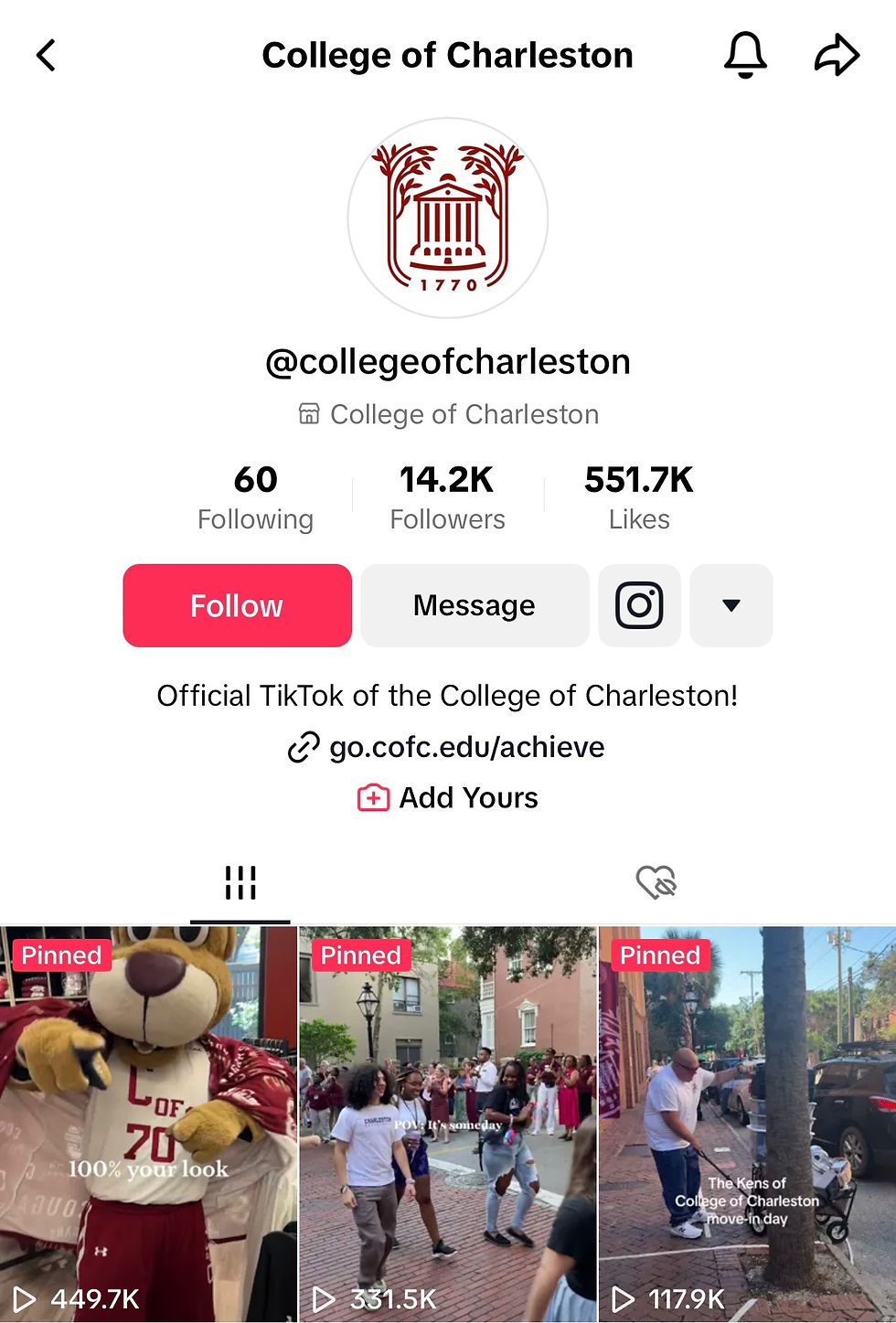
Holdridge also credited the College’s social media presence with helping its student population grow, particularly through content shared by students and the marketing team.
However, digital outreach is only one part of the College’s recruiting strategy. Holdridge visits more than 150 high schools each year to meet with students and counselors, allowing her to answer questions and introduce students ot the college directly.
“Being intentional with our time and meeting students where they are is valuable,” Holdridge said. “I think that's probably one of our most effective strategies.”
The college also employs regional representatives who live in areas where prospective students are located. Having someone nearby who understands The College can make the process feel more personal for students considering a school far from home. Admissions counselors also build relationships with students during recruitment visits, creating connections that can influence their decisions, Drewry pointed out.
Although The College actively recruits across the country, Drewry believes its appeal extends beyond its marketing efforts.
“At the same time, we don’t have to do all the recruiting ourselves,” Drewry said. “I always tell students that The College sells itself.”
For some students, leaving home provides an opportunity to experience a different environment, but attending college in an entirely unfamiliar place can also feel intimidating.
Anna said her decision to attend CofC was partly influenced by her desire to leave Tennessee and experience something new. Her parents wanted her to attend an out-of-state school, and Charleston was a manageable distance compared to her other option, NYU.
“It was a good middle ground,” Davidson said. “I could go away from home, like my parents wanted, without going too far away. I feel like it was a good distance.”
The drive from her hometown takes about six and a half hours, allowing her to return home for holidays and school breaks. Although traveling can be difficult, Anna said she ultimately found the distance workable.
Her experience reflects a broader appeal that admissions representatives see among students looking for a change without moving into an environment that feels completely unfamiliar.
“I think a lot of students want to do something different,” Drewry said. “I was one of them back in 2011. Charleston’s culture is different.”
Drewry said The College encourages students to step outside their comfort zones, explore a new city, and become more independent.
Holdridge similarly said that students from rural areas may appreciate Charleston as an introduction to a more urban environment without the intensity of a much larger city.
“Being in a more urban environment without feeling overwhelmed by a large city is important to many students,” Holdridge said.
Charleston's accessibility can also help students feel more comfortable about attending a college far from home.
Drewry said many students she works with live within an hour of an airport, followed by a roughly two-hour flight and a 20-minute drive to campus. In Anna's case, she said flying home to Tennessee can be expensive and that driving is sometimes the more practical option.
Beyond location and recruitment, admissions representatives point to the college's campus community as another reason students choose Charleston over schools closer to home.
With an enrollment of about 11,000 students, the college offers students a university-sized experience while maintaining opportunities for personal connections with faculty members.
“Our medium-sized enrollment of about 11,000 students also plays a big role,” Drewry said. “Students get to know their professors.”
Drewry describes The College as a place where students can experience a large school atmosphere outside the classroom while benefiting from a smaller academic environment. She said relationships with professors can continue to matter long after a class ends.
Holdridge also emphasized the accessibility of faculty members and administrators.
Through campus events and opportunities to connect with representatives from different academic programs, prospective students can get a better sense of the relationships they may build after enrolling.
“Our campus has a welcoming environment where people are open to meeting students and connecting with faculty members,” Holdridge said.
She added that professors and faculty members genuinely care about students and recognize their individual strengths. That environment can help students feel supported as they adjust to a new school and community.
Davidson’s experience in the biology department reflects that emphasis on personal relationships.
“I love the school,” she said. “I can’t really speak for any other program outside of the biology department, but I love the department, and I love my professors.”
Out-of-state students have opportunities to build relationships with professors and explore their academic interests with support.
Holdridge said students are encouraged to reach out directly to faculty members and deans, giving them opportunities to learn more about programs and establish connections that may be harder to access at larger universities.
For Drewry, Charleston's connection is part of what makes The College so distinctive. She recognizes that Charleston and CofC are not the right fit for everyone, but she believes that students drawn to the school’s environment can find a home here.
“I think The College offers a different college experience in general, but not in a bad way,” Drewry said. “We don’t have football, and we’re in the city. As I mentioned earlier, we’re not for everyone, and that's OK. But for students who are a good fit, it can be the perfect place for them.”


Comments